
Cycle Tour | Circumnavigation of the Iberian Peninsula, Including the Med. Coasts of S. France & S. Italy I Stage #7
Stage 7: Along the Mediteranen Coast of Spain to La Jonquera, Catalonia
Spain & Southern France – Coastal Retracing & Southern Winds
Turning along Spain’s sunny Mediterranean coast, I retraced parts of the outward route, passing through Tarifa, Cádiz, and the Costa del Sol, feeling the wind, waves, and the thrill of the southernmost edge of Europe.
Leaving Spain at La Jonquera, a town in the province of Girona that sits directly on the Pyrenees border with France, opposite the French town of Le Perthus, I continued north along the familiar Mediterranean coast.
ROUTE STAGES WITH GOPRO VIDEOS
Stage 7 - Day 46: Delfín Verde Hostel, Almería → Camping Bellavista, Águilas (Costa Cálida) I Spain 📍 MAP
The day began with sunshine streaming through the window of my room at Delfín Verde Hostel. After a breakfast of supplies I’d bought the night before, I packed up and set off along the seafront path, the Mediterranean sparkling on my left.
Beaches lined with palm trees and sand sculptures created by a local artist caught my eye before I reached Costacabana. From here, curiosity drew me onto a dirt track that wound east through barren, arid hills dotted with abandoned buildings. At one steep slope I had to push my bike, and from the crest I glimpsed the highway in the distance. Here I met a local cyclist, briefly chatted, then we parted ways he back toward Almería, I onward into the unknown.
The track led me to a quieter secondary road through Níjar, where vast fields of greenhouses stretched endlessly, and then into Fernán Pérez. Suddenly the landscape opened onto one of Andalusia’s treasures: the Cabo de Gata–Níjar Natural Park, a wild and rugged protected area with volcanic cliffs, jagged outcrops, and hidden coves accessible only on foot.
Every climb and descent revealed new vistas of desert slopes meeting the Mediterranean, making each pedal stroke a thrill.
I stopped for lunch in the whitewashed village of Agua Amarga, nestled between hills and close to the sea. Its serene square, quiet streets, and timeless atmosphere were a perfect pause.
The route then carried me inland across semi-desert terrain before gradually returning to the coast at Carboneras, a lively town on the edge of the park. From here the road unfolded like a balcony above the sea, with panoramic terraces offering spectacular views.
In Macena, I admired the restored Castillo de San Ramón with its twin circular towers, and further along, in Villaricos, the 18th-century Castillo de Villaricos stood as a silent guardian over the shoreline.
By late afternoon I reached Camping & Bungalows Bellavista, just south of Águilas on the Costa Cálida.
After pitching my tent, I walked to Playa Matalentisco, a Blue Flag beach with a dog area, where sturdy Civil War bunkers stood quietly against the sea.
Back at the campsite, I bought dinner at the shop, sent a few messages to friends, and mapped out the next day’s stage before falling asleep, lulled by the sound of the waves and the quiet of the Costa Cálida.
Stage 7 - Day 44: BQ Andalucía Beach Hotel, Torre del Mar (Málaga) → Camping Castillo de Baños, Polopos (Granada Coast) I Spain 📍 MAP
Sunlight poured into my hotel room, waking me early. I enjoyed the wide breakfast buffet downstairs, surrounded by the chatter of tour groups in many different languages. The variety was so abundant I knew I wouldn’t need food again until evening.
Tempted as I was by the hotel pool, the road was calling. I packed the panniers, set off along the palm-lined promenade of Torre del Mar, and soon left the town behind.
The only coastal road meandered gently, climbing and dipping past Torrox-Costa until the striking arches of the Eagle Aqueduct (Puente del Águila) came into view near Nerja. Still in use today, it stood proud against the landscape, a testament to 19th-century engineering.
The route traced the dramatic cliffs of Punta de la Mona, revealing Almuñécar nestled between sea, valley, and mountains. After the tunnel at the promontory, the whitewashed town of Salobreña appeared, crowned by its hilltop castle. Beyond Motril, another tunnel led to open coastal views, with villages like Gualchos, Lújar, and Rubite overlooking vast beaches washed by clear waters.
By late afternoon, I rolled into the quiet coastal hamlet of Castillo de Baños. My stop was Camping Castillo de Baños, a small seaside campsite with pitches, bungalows, and a pool. I set up my tent under the curious gaze of local cats, then wandered the village: its preserved fortress, beach, and a small supermarket where I bought dinner. The shop was run by a friendly Chinese-Spanish owner, who spoke fondly of the village’s peace despite its tiny population.
As night fell, I sat outside my tent, eating simply, listening to the surf. The sea was just a few steps away, and its rhythm carried me into sleep. were the gentle waves breaking on the shore. With that soothing rhythm as my lullaby, I drifted off to sleep, ready for the road ahead.
Stage 7 - Day 45: Camping Castillo Baños, Polopos in the Coast of Granada → Hostel Delfin Verde, Almeria I Spain 📍 MAP
Dawn broke with a sky painted in soft colors. I walked around the campsite, enjoying the calm sea before breaking down the tent and packing the bike. The cats returned for breakfast, and I shared a little of mine before pedaling off.
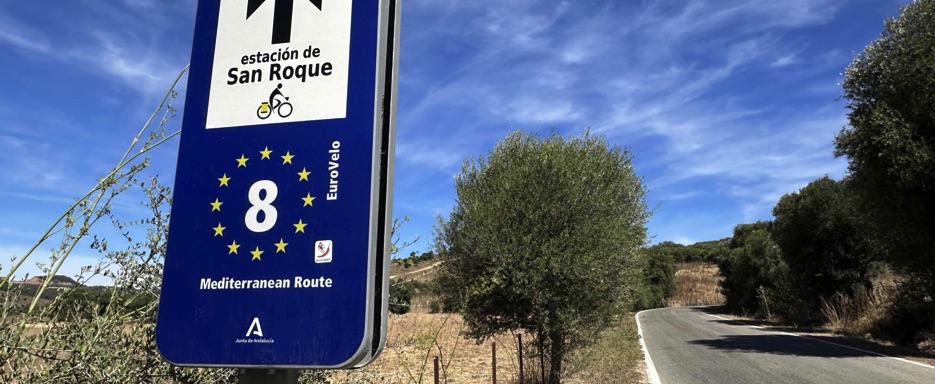
The EuroVelo 8 once again narrowed to the only available road, weaving through stretches of coastline and semi-desert terrain. Near El Pozuelo, beneath a towering highway bridge, I encountered a fellow touring cyclist riding in the opposite direction. We paused for a brief exchange of greetings and stories before each continuing along our separate paths.
The road wound into Adra, where I followed a seaside bike path shaded by palms and lined with empty beaches and a small port. Further inland, the scenery shifted abruptly. From El Ejido to La Gangosa, the land became the “Mar de Plástico”—an endless sea of white greenhouse sheets, where fruit and vegetables grow under plastic roofs. It was vast, almost surreal, yet unsettling, with windblown plastic littering the roadsides and threatening the sea.
Leaving this stark agricultural landscape, the coast returned, rugged and beautiful, with coves and cliffs near Torrenueva Costa, Calahonda, and Castell de Ferro.
By evening, I reached Almería, capital of the province and gateway to the Cabo de Gata. My stay was at the Hostel Delfín Verde, a modest but charming guesthouse on the seafront promenade. My room had a stunning sea view, and my bike was welcome inside. At the entrance, photos of the Beatles hung on the walls according to the staff, the band had once stayed there.
Dinner was a simple meal I bought nearby and ate in my room before strolling the promenade and beaches of fine sand and clear water.
Later, I returned to my room, checked Google Maps to consider tomorrow’s destination, and ended the day as always: watching the sea and drifting to sleep with the sound of the waves.
Stage 7 - Day 47: Camping Bellavista, Águilas (Costa Cálida) → Camping Lo Monte, Torre de la Horadada, Alicante (Costa Blanca) I Spain 📍 MAP
I woke up to cloudy skies, packed up my tent, and loaded my bike before setting off along the coast. The route took me through the charming town of Águilas, with its waterfront promenade, golden beaches, and the majestic castle overlooking the bay between Punta Negra and Punta de la Águilica.
Soon, the EuroVelo 8 led me along the hilly stretches of the Cabo Cope and Puntas de Calnegre Natural Park, a protected coastal area where panoramic views of the Mediterranean unfolded at every turn. The ups and downs were challenging but rewarding, with quiet rural landscapes and glimpses of the sea across the valleys.
I stopped briefly in Mazarrón, taking in the wide Playa del Alamillo and its promenade. Here I met Barbara, a German cyclist, cheerful and friendly, heading on her own journey. We exchanged stories and wished each other well before continuing.
The road then wound along the coast from Los Alcázares, past sandy beaches of the Mar Menor, through small towns and inland stretches of farmland. The contrast between the tranquil lagoon and the open sea was striking, a reminder of how varied the landscapes of Spain’s southeast can be.
By late afternoon I arrived at Camping Lo Monte, a spacious campsite with mostly caravans and campers. Despite being charged a high price for my small tent pitch, I was grateful for the quiet green space nearby.
I set up my tent, bought dinner at the campsite market, and followed my usual evening routine, preparing for the next day’s journey along the Costa Blanca.
Stage 7 - Day 48: : Camping Lo Monte, Torre de la Horadada → Camping Santa Clara, Altea (Costa Blanca, Alicante)I Spain 📍 MAP
I woke up early, packed my tent, and loaded my bike. The day began along the N-332, a road winding gently up and down just inland from the coast.
I pedaled past the towns of Dehesa de Campoamor and Torrevieja, skimming the edge of the Lagunas de la Mata-Torrevieja Natural Park, where two large saltwater lagoons reflected the morning light. On my right, the Mediterranean shimmered, and the contrast between sea and salt flats created a striking scene.
The route continued through Guardamar del Segura, surrounded by lemon groves, and crossed the Segura River via an iron bridge. Passing La Marina and Santo Polo, I skirted the Salinas de Santa Pola Natural Park, its scented marshes alive with birdlife.
Reaching the port of Alicante, I paused on a bench, watching the calm waters, the moored boats, and the bustling promenade. Then, heading north, the road climbed through El Campello, past Villajoyosa, and Benidorm, with spectacular mountain and sea views.
By late afternoon, I arrived at Camping Santa Clara, just two kilometers from Altea. The campsite was peaceful, with many empty pitches due to the low season. After setting up my tent, I walked to a nearby supermarket to buy dinner and returned to eat near my tent.
The staff kindly allowed me to use a small, empty bungalow to sit comfortably, a gesture that made the day feel even more pleasant.
As always, I checked the route for the next day on Google Maps and Komoot, then fell asleep to the quiet of the campsite, ready for another day along the Costa Blanca.
Stage 7 - Day 49: Santa Clara Campsite, Altea (Costa Blanca), Alicante → Hostal Andrés, El Saler (Albufera Nature Reserve), Valencia I Spain 📍 MAP
I woke up to cloudy skies with occasional patches of blue. After packing up my tent and loading the bike, I had a simple breakfast of provisions I’d bought the night before.
Rolling out along the campsite road, I was greeted by two friendly couples in camper vans, who wished me a good journey—a small kindness that brightened the start of the day.
Leaving Altea, I pedaled through the town center and along the wide seafront promenade, lined with palm trees and opening onto the sparkling Mediterranean.
Soon I joined the scenic N-332 coastal road, climbing steadily along the dramatic promontory of El Morro de Toix between Altea and Calpe. From the 200-meter cliff, the view stretched across the coast to the massive Peñón d’Ifach, towering above Calpe’s bay like a smaller version of the Rock of Gibraltar.
The climb continued past rugged formations such as the Mar Morta and Roques Negres, their reddish-orange rocks pierced with giant hollows, creating a surreal and striking landscape. The road eventually descended into Benissa, before threading through artisan towns like Gata de Gorgos, displaying workshops with handcrafted goods, and Ondara, nestled among orange groves and mountains.
I skirted the municipalities of Oliva and Gandia, spotting a few fellow cyclists along the way, before reaching Tavernes de la Valldigna, Bega, and finally Cullera, where the Cullera Castle perched high above the town on its hilltop.
The final stretch led north to the small village of El Saler, south of Valencia, on the edge of the Albufera Natural Park, with its white sand beaches and natural dunes. I checked into Hostal Andrés, stored my bike safely in the garage, and settled into a spacious room with a small balcony and chairs.
For dinner, I visited a nearby shop and ate quietly on the balcony. Later, I took a short evening stroll to Port de El Saler (Puerto Albufera), just ten minutes away.
The sun was setting, painting the sky in shades of red that reflected on the calm waters where fishing boats rested. I glimpsed the nearby beaches, though darkness was settling in.
Back at the hostal, I completed my usual evening routine sending messages and checking tomorrow’s route before falling asleep, lulled by the gentle quiet of El Saler and the promise of the journey ahead.
Stage 7 - Day 51: Camping Torrenostra (Torreblanca), Castelló, Costa del Azahar → Camping Joan Bungalow Park Cambrils (Costa Daurata), Tarragona I Spain 📍 MAP
I woke up while it was still dark, packing my tent quickly to escape the mosquitoes. The day ahead would take me from the Costa del Azahar to the Costa Daurada, along a mix of coastal roads and quiet inland paths.
The route began flat, then rolled gently through olive groves and the Serra d’Irta Natural Park, a protected area along the coast of the Irta Marine Reserve. I passed Sant Carles de la Ràpita, a town known for its mussel farms, before skirting Amposta, close to the Ebro Delta Natural Park with its rice fields, lagoons, and sandy beaches.
Climbing inland to El Perelló, I descended past L’Ametlla de Mar and L’Hospitalet de l’Infant, the Mediterranean glinting under a clear blue sky. The coast appeared intermittently, framed by small beaches and rugged cliffs.
By evening, I reached Cambrils, on the Costa Daurada, and checked into Camping Joan Bungalow Park, a lively, family-friendly site with swimming pools, a gym, bicycle rentals, a bar-restaurant, and a well-stocked supermarket. I pitched my tent, met a friendly couple of campers who offered me access to electricity for charging devices, and then did my laundry in the large facility.
Dinner came from the campsite shop, eaten near my tent, and I paused to enjoy music from a small band performing at the bar.
Later, I took a stroll to the beach and nearby surroundings before returning to my tent. The forecast promised rain overnight, so I settled in early, ready for whatever the next day would bring along the Mediterranean coast.
Stage & - Day 52: Camping Joan Bungalow Park, Cambrils → Hotel El Tiburón, Castelldefels (Costa del Garraf), Barcelona I Spain 📍 MAP
I woke up to rain, but after quickly packing my tent, my camping neighbors invited me for breakfast on their camper veranda, along with their cat—a small kindness that made the rainy morning brighter.
Leaving Camping Joan Bungalow Park, the rain eased, and I pedaled along the Cambrils seafront bike path, enjoying the calm Mediterranean waters and the city awakening along the promenade. The coastal scenery stretched before me, the sea on one side and charming buildings on the other.'
Continuing toward Salou and the Costa Dorada, I followed the coastal road to Tarragona, where I climbed a small promontory to reach the Roman Amphitheater in Parc de l'Anfiteatro, a historic site with stunning views over the Mediterranean. The ancient stones and the sound of the waves below created a striking contrast.
As I pedaled onward, the rain returned near Roda de Barà, passing the Arc de Triomf de Barà, a Roman triumphal arch.
I stopped at a nearby bar for a Coca-Cola, not just for refreshment, but to wait out the downpour. After a short pause, the skies cleared, and I resumed my ride.
The route then took me along Coma-ruga, a seaside resort in El Vendrell. The rain had stopped, and a few sun rays warmed my face as I removed my wet shoe covers and stretched my legs along the promenade.
Continuing along bike paths and quiet local roads, I passed several charming villages and beaches, enjoying the quiet coastal atmosphere.
I reached Sitges, renowned for its film festival, Carnival, and LGBTQ culture, and soaked in the vibrant seaside town before entering the rugged landscapes of the Garraf Natural Park, where cliffs and Mediterranean vegetation created dramatic scenery along the coastline.
Finally, I arrived at Castelldefels, my destination for the day. I stayed at Hotel El Tiburón, a small, family-run hotel just a minute’s walk from the long sandy beach.
The friendly staff welcomed me warmly, and after unpacking and storing my bike safely, I enjoyed dinner and a short break on my balcony, listening to the waves and watching the last light fade over the sea. Later, I settled in for the night, reflecting on the day’s rainy yet beautiful ride, ready for the next stage along the Catalan coast.
Stage 7 - Day 53: Hotel El Tiburón, Castelldefels (Costa del Garraf), Barcelona→ Camping Globo, Canet de Mar, Barcelona I Spain 📍 MAP
This morning the sun greeted me warmly as I had breakfast at the Hotel El Tiburón’s restaurant. After packing my bike and loading my bags, I set off toward Barcelona, eager for the ride along the Catalan coast.
The bike path from Castelldefels to Barcelona was flat and scenic, following the Mediterranean closely. I pedaled past charming coastal towns like Gavà, with its waterfront promenade and sandy beaches, enjoying the panoramic sea views that made the morning ride so relaxing. The Mediterranean shimmered beside me, and the fresh sea breeze kept me alert and happy.
Reaching Barcelona, I explored the city by bike, taking advantage of its extensive network of bike paths. I rode through vibrant neighborhoods, passed historical landmarks, and admired some of Gaudí’s iconic works, feeling the pulse of the city while enjoying the freedom of cycling through its lively streets.
After soaking in the urban energy, I continued along the coastal bike paths, passing Badalona Beach and Montgat Beach, taking a brief stop at a local service station to wash my bike. The route then wound through Mataró and Arenys de Mar, before arriving at Canet de Mar, a peaceful town on the Costa del Maresme.
Here, I stayed at Camping Globo, a wooded campsite with three outdoor pools, located a short walk from the Mediterranean’s sandy beaches.
Since it was the last day of operation for the season, the campsite was nearly empty a quiet, fortunate respite. After pitching my tent, I wandered around the area, discovering a small local restaurant with outdoor seating where I enjoyed a relaxed dinner surrounded by locals.
Back at the campsite, I reflected on my journey through Spain the diverse landscapes, vibrant cities, warm and welcoming people, and the natural beauty that had accompanied me throughout the stage.
Tomorrow I would continue my journey into France, but tonight I savored my last evening in this magnificent country, grateful for every experience along the way.
Stage 7 - Day 54: Camping Globo, Canet de Mar → Hotel La Jonquera, La Jonquera, Girona I Spain 📍 MAP
This morning, the sky was cloudy as I had a quick breakfast I’d bought the night before at a roadside gas station. After dismantling my tent and loading my bags onto the bike racks, I set off along the coast, pedaling through the charming seaside towns of Sant Pol de Mar, Calella, Pineda de Mar, and Malgrat de Mar.
Soon, the coastal scenery gave way to rolling inland countryside. The road offered a variety of landscapes - fields, scattered villages, and quiet country lanes. I passed through Sant Pere, Fornells de la Selva, Girona, Medinyà, Bàscara, Figueres, Pont de Molins, and finally La Jonquera.
The town sits in the Alto Ampurdán region of Girona, just about 5 km from the French border, making it a key gateway between Spain and France.
At Hotel La Jonquera, I found a charming and spacious place with friendly staff, where I could even bring my bike into the room. After settling in, I took a short stroll around the town.
La Jonquera is primarily a commercial hub popular with cross-border travelers, filled with restaurants, bars, gas stations, and supermarkets stocked with high-quality international products. I picked up my dinner at one of these shops.
Back at the hotel, I enjoyed a quiet meal, reflecting on my journey through Spain the diverse landscapes, vibrant cities, and the warm, welcoming people I had met along the way.
Tomorrow, I would continue into France, leaving behind this magnificent country rich in natural beauty, culture, and unforgettable experiences. Goodbye, Spain!
Stage 7 - Day 43: Bed & Breakfast, Manilva, San Luis De Babinillas → BQ Andalucía Beach Hotel, Torre del Mar, MálagaI Spain 📍 MAP
The morning greeted me with sunlight spilling across the sky as I left my cozy B&B in Manilva. With my panniers loaded and the bike ready, I rode down to the beach, following the San Luis de Sabinillas seafront.
The Mediterranean was calm, its surface glowing with the first rays of the day, and the EuroVelo 8 route carried me along the Costa del Sol.
The ride led me through some of Spain’s most famous seaside towns Estepona, Marbella, Mijas, Fuengirola, and Benalmádena each boasting long stretches of golden sand. Southwest of Málaga, I passed through the Guadalhorce Natural Park and the sandy beach of San Andrés (Huelin) before reaching Vélez-Málaga. Near Benajarafe, the Torre Moya stood watch on its promontory, a reminder of centuries past.
By evening, I arrived at Torre del Mar, part of Vélez-Málaga, and checked into the BQ Andalucía Beach Hotel. The town unfolded along a lively promenade with beaches like Playa del Poniente and Playa del Faro, all equipped with every convenience.
Later, I explored the historic corners of Torre del Mar, visiting the Church of San Andrés, the Sugar Museum, and the Plaza de la Axarquía with its elegant white circular house. The Castillo del Marqués, once a fortress, existed now only in memory—no castle to see, no model of its walls.
Dinner was at a local restaurant with outdoor seating, surrounded by the hum of the town. Back in my spacious hotel room, overlooking the pool and restaurant, I reviewed tomorrow’s stage. It looked straightforward just a continuation along the coast. After sending a few messages to friends and family, I fell asleep, lulled by the promise of the next ride.
Stage 7 - Day 50: Hostal Andrés, El Saler, Valencia → Camping Torrenostra (Torreblanca), Castelló, Costa del Azahar I Spain 📍 MAP
I woke up very early, as the days are shortening in October, and I wanted to maximize daylight. Breakfast was quick in my room, then I packed up, attached the bags to my bike, and left El Saler behind. Riding along the bike path between L’Albufera and the sea, the early sunlight danced on the calm Mediterranean waters, creating a serene start to the day.
I cycled into Valencia, exploring the Turia Gardens, the former riverbed now transformed into a vast urban park with smooth cycle paths, and admired the futuristic City of Arts and Sciences. Exiting the city, the EuroVelo 8 led me toward Sagunt, passing agricultural fields, mandarin orchards, and peaceful villages. Paved paths, gentle slopes, and occasional small bridges made this stretch relaxing and scenic.
From Puçol to Sagunto, I followed the Ojos Negros Greenway, a shared cycling and walking trail along the former railway line. Lemon and orange groves framed the route, and the fortress in Sagunto offered panoramic views over the town and coast. Skirting villages such as Xilxes, I finally reached the Mediterranean again.
By evening, I arrived in Torrenostra, a small coastal town on the Costa del Azahar, and checked into Camping Torrenostra, located within the Prat de Cabanes-Torreblanca Natural Park, one of Europe’s important wetlands. The campsite was quiet in the low season but teeming with mosquitoes! I hurriedly pitched my tent, then escaped the swarm by cycling to the seafront promenade and the long sandy beach.
I celebrated my birthday there, writing wishes on the sand and soaking in the peaceful surroundings. A couple of restaurants with outdoor seating allowed me to enjoy dinner away from the mosquitoes.
Returning to the tent, I carefully secured my space before falling asleep, already planning to leave early the next morning to stay ahead of the swarms.