
Cycle Tour | Circumnavigation of the Iberian Peninsula, Including the Med. Coasts of S. France & S. Italy I Stage #3
Stage 3: French Pre-Alps – Pyrenees Coast to Coast
Eastern French Pyrenees: France – Rugged Peaks
Crossing the eastern slopes of the French Pyrenees, the peaks rose like silent guardians. The terrain tested both my legs and my resolve, with climbs and descents that reminded me why I love cycling through mountains. Every switchback revealed dramatic valleys, rushing streams, and jagged summits that made every pedal stroke worth the effort.
“In the Pre-Alps, the mountains speak in silence but their challenge is a conversation every cyclist can’t resist.”
Route Stages with GoPro Videos
Stage 3 – Day 9: Camping Cap Leucate, Leucate → Camping de l'Agly, Saint-Paul-de-Fenouillet I France 📍 MAP
This morning I woke to sunshine and mild temperatures. After dismantling my tent and gear, I chatted briefly with German, the cyclist I had met the night before, before setting off with Girasole. Girasole is the name I gave my bike when I had it built, and it is also the name inscribed on its frame.
The EuroVelo 8 soon led me to Le Barcarès, a small coastal village nestled between the wide, sunny beaches of the Mediterranean and the first slopes of the Pyrénées-Orientales. From there, I joined the Piémont Pyrénéen, also known as Vélosud (V81), the long-distance cycle route that runs along the foothills of the French Pyrenees from the Mediterranean to the Atlantic.
From Le Barcarès, I rode toward Claira and Rivesaltes along the Via Verde cycle path that follows the Agly River. The ride was breathtaking: sparkling water ran to one side, while endless orchards stretched to the other, all under the watchful silhouette of Mont Canigou rising proudly in the distance.
The Vélosud gently climbed through Peyrestres, Cases-de-Pènes, and Estagel, before bringing me to Saint-Paul-de-Fenouillet, a rural gem nestled in the heart of the Fenouillèdes region in southern France.
This evening I stayed at Camping de l'Agly, where the kind lady at the front desk warmly welcomed me and showed me to a shaded pitch. The campsite, lying between the Agly River, the surrounding mountains, and the village shops, was the perfect place to rest after a long day of cycling.
As night fell, I washed my clothes, prepared a simple dinner, and replied to some messages from family and friends. Later, I studied the map for the next stage of my journey before falling asleep under the clear Pyrenean sky.
Stage 3 – Day 10: Camping de l'Agly, Saint-Paul-de-Fenouillet → Hotel Castel d'Olmes, Laroque-d'OlmesI France 📍 MAP
The morning began under a soft blanket of clouds. After my usual camping routine, I stopped to greet the woman who worked at the campsite.
I wasn’t sure if she was the owner, but her kindness during my stay had left a strong impression. We snapped a quick photo, shared a warm hug, and then I set off to begin the day’s ride.
My plan was to follow the D117 secondary road, which promised a winding journey through the Gorges de la Pierre-Lys—a place I had long been eager to see.
The road rose gently, never too steep, weaving through a sea of green. Far in the distance, the high Pyrenean peaks stood proud, while closer by, rolling agricultural hills stretched toward the horizon.
I passed through Caudiès-de-Fenouillèdes and reached Saint-Martin-Lys, a small village in the upper Aude River valley, perched right at the entrance to the gorge that bears its name.
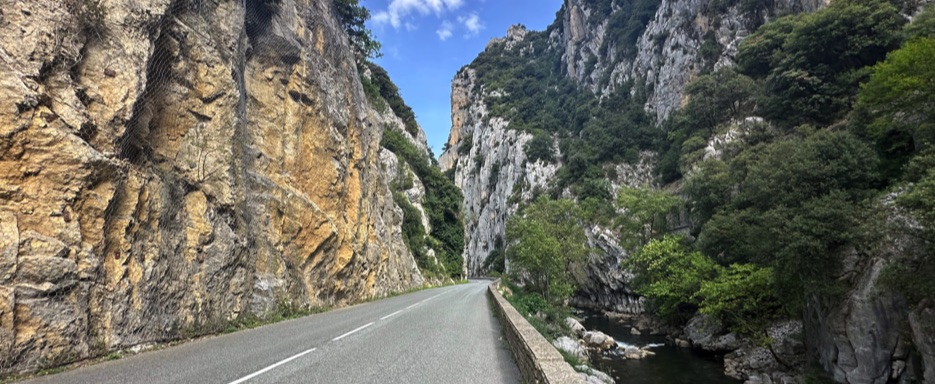
From Saint-Martin-Lys to Belvianes and then Quillan, the route plunged into the very heart of the gorge. Here, the Aude River had carved a narrow passage between towering cliffs, their sheer rock faces looming on either side.
Pedaling between these massive walls, with the river rushing below, I knew I had made the right decision to skip the cycle path. Each bend revealed another postcard-worthy view.
In Quillan, I stopped at a well-maintained roadside rest area, complete with restrooms and information panels about the surrounding region. After a short break, I resumed climbing—still at an easy, steady pace through landscapes that grew increasingly rugged and wild. Eventually, I reached Col du Portel, standing at 601 meters above sea level.
From there, the road rolled on at high altitude, offering light descents through Brenac, Puivert, Bélesta (on the banks of the Hers-Vif River), L’Aiguillon, Saint-Jean-d’Aigues-Vives, and Lavelanet, before finally bringing me to Laroque-d’Olmes, a small town in the Ariège department of the Occitanie region.
In Laroque-d'Olmes, I stayed at the Hotel Castel d'Olmes, a charming family-run hotel with a pool and restaurant though, unfortunately, the restaurant was closed that evening. With no supermarket or other restaurants nearby, I was grateful for the emergency food I always keep in my bike bag; tonight, it proved useful.
I sat by the window, enjoying a simple meal as rain began to fall. At that moment, I was glad I wasn’t camping, though I knew the next day’s ride would almost certainly be rainy.
I ended the evening by replying to some messages from family and friends, then checked Google Maps and Komoot to plan the next stage of my journey.
Stage 3 - Day 11: Hotel Castel d'Olmes, Lareque-d'Olme → Hotel/Camping Parc de Palétès, Saint-Girons I France 📍 MAP
I woke up and pulled back the curtains of my hotel room and, as expected, rain streaked the glass. Fortunately, breakfast was included in the stay: a simple coffee (or other drink of choice), croissants, sliced bread, and jam.
While I was eating, the hotel owner joined me. Over a brief chat, he mentioned that his parents were Italian. We spoke for a few minutes, then exchanged goodbyes.
I retrieved my bike from the hotel’s storage room and, well-protected against the rain, began pedaling along the D117 secondary road. With no bike paths in the area, this quiet, nearly traffic-free route offered a slow, steady climb through lush rural landscapes, passing through Laroque-d’Olmes, Dreuilhe, Lavelanet, and Nalzen.
From Nalzen, the clouds began to thin, and the road descended past Celles, Saint-Paul-de-Jarrat, and Montgailhard, bringing me to Foix—a charming medieval town at the confluence of the Ariège and Arget rivers, crowned by its imposing hilltop castle.
From Foix, I alternated between the D117 and the V81 cycle path, which ran parallel and were both free of traffic. The road climbed gently to the Col du Bouich (599 m) in Saint-Martin-de-Caralp, before descending through La Bastide-de-Sérou, Castelnau, and Durban.
Another modest climb followed, then a smooth, quiet descent through Lescure, where the scenery opened into the Barguillère Valley distant mountain peaks, green pastures dotted with grazing animals, and peaceful farmland stretching toward the horizon.
Here, I reached my destination for the day: Saint-Girons, nestled in the Ariège Pyrenees. A few kilometers from the center, I arrived at Camping Parc de Palétès, which offered everything from tent pitches to bungalows, plus a swimming pool, a small market, and a restaurant.
With drizzle falling and heavier rain forecast for the night (and likely the next day), I opted for a room that happened to be available. The accommodations were a bit unusual: a long corridor led to the rooms, with a small nook along the way equipped with a microwave and kettle. My room was simple but cozy, with a balcony overlooking the lush valley. The steady sound of rain made the view even more tranquil.
After settling in and going through my usual evening routine, I headed to the campsite restaurant for dinner, where I was greeted by a magnificent beige cat with an impressively long tail. Later, back in my room, I checked the maps for the next day’s route before drifting off to sleep to the soothing sound of rain through the half-open window.
Stage 3 – Day 12: Hotel/Camping Parc de Palétès, Saint-Girons → Camping Les Craouès, Capvern I France 📍 MAP
This morning, I opened the curtains and was greeted by bright sunshine—a welcome surprise, considering the previous evening’s forecast had promised rain. I certainly wasn’t complaining.
Since my bike had spent the night with me in the room, fully loaded, there was no need to unpack or re-hang the bags, which made it quicker to leave. Shortly afterward, I sat down to breakfast at the campsite restaurant: creamy yogurt, buttery croissants, and a fresh baguette to slice and top with jam. There was also orange juice, coffee, and everything I needed to start the day.
Leaving the campsite, I followed a local road through Saint-Girons, crossing a bridge over the Salat River before continuing on to Caumoni, Castagnède, and Mane. Soon after, I reached the V81 cycle path, where signs pointed in different directions. I chose the one toward Montsaunes but somehow ended up on a quiet side road probably because I’d missed a sign.
The road climbed gently, leading me to Lestelle-de-Saint-Martory, where I rejoined the V81. Here, the route wound along country roads bordered by lush vegetation and wide expanses of farmland. Tall fields of golden sunflowers were particularly breathtaking.
In Labarthe-Inard, I passed the Church of the Nativity of the Virgin and encountered two cyclists on a narrow road. Shortly after, I entered Estancarbon, passing the Church of Notre-Dame. From there, the climb steepened, winding through fields of wheat and past wild horses, before reaching the rural outskirts of Saint-Gaudens.
At this point, the V81 split into several options. To simplify my route, I followed the D817 provincial road past Saint-Gaudens and Valentine, where I stopped at a market to buy water and a snack.
The ride continued along a quiet country road lined with hay bales, through Huos and around Montréjeau, until I reached Pointis-de-Rivière. There, I met another cyclist and we chatted briefly before parting ways.
The final stretch took me through Cantous and Mazères-de-Neste before arriving in Capvern, in the Hautes-Pyrénées. Just outside the city, near the Neste River, I found Camping Les Craouès.
The campsite was almost deserted it was low season, and some facilities were closed. With rain forecast for the evening, I pitched my tent in the shelter of one of the buildings, ensuring a dry and comfortable night’s sleep.
Stage 3 - Day 13: Camping Les Craouès, Capvern, at the foot of the Pyrenees → Hotel Monford, LourdesI France 📍 MAP
It had rained all night. Luckily, I had pitched my tent under one of the campsite's covered structures. I couldn't leave as early as I'd liked: the rain was simply too heavy, but in summer, showers like that pass quickly. In fact, about an hour later, the rain eased, and I was able to pack up my tent completely dry, grateful for my decision to shelter under those structures, now closed for the season.
Dismantling my Hubba Hubba Bikepack 1-person tent was quick thanks to its compact design. My Ortlieb bags were already attached to the rack, except for the handlebar bag, the one that holds my essentials, which is easy to remove and reattach.
And so I set off, under cloudy skies and a light drizzle that kept me company throughout the journey. I left Camping Les Craouès via quiet country roads, gently descending through green hills dotted with small houses. It didn't feel like summer, but rather like a gray, foggy winter morning.
Passing through Molère, I found it completely deserted, its stillness extending across the landscape. Then it was Mauvezin's turn: a charming village in the heart of the Hautes-Pyrénées countryside, its narrow streets framed by views of lush mountains. In Castillon, I encountered the only car I'd see for a while: the driver slowed to warn me of a bull roaming nearby. I’d encountered bears before, during a cycling trip in British Columbia, Canada but a wild bull? That was new. I scanned the side of the road but never saw one.
The rain stopped, and I continued pedaling along the narrow roads. A friendly dog appeared and trotted ahead of me for a while, as if guiding, or perhaps discouraging, me on a climb. Then it disappeared, leaving me alone among the rolling green hills and pristine nature.
Through a series of small villages, descending, I finally reached Montgaillard, where a sign for the Sentier pieds nus ("barefoot path") invited visitors to reconnect with nature through a sensory walk. Tempting, but the road was calling. I continued through Loucrup, Escoubès-Pouts, and finally arrived at my day's destination: Lourdes.
I'd been here before on another bike trip, but Lourdes is the kind of place that retains its magic, even for a non-believer like me. Beyond its religious significance, it embodies a universal calm, a blend of architectural beauty, spectacular landscapes, and a collective spiritual energy that seems to calm the mind.
I checked into the Hotel Monfort, where the woman at the front desk warmly welcomed me. My bike found a safe place inside the hotel, and my room had a balcony overlooking the distant Sanctuary of Our Lady.
With the rain still falling, I put on my jacket and walked toward the city. Lourdes Castle loomed above, watching over the city and the Sanctuary. At the Grotto of Massabielle, pilgrims filled bottles with holy water from the fountains.
I had promised friends and family that I would bring holy water, so I bought some small bottles at a souvenir shop. But when I returned to the Sanctuary, a torchlight procession was already underway, and the only way to reach the fountains was to join it.
And so I did, walking with the faithful until I finally managed to fill my bottles. When I returned to the hotel, it was later than expected, but I kept my promise. Space in my bags was limited, but I would make it. The forecast for the next day was for more rain. I glanced at my next destination, then closed my eyes and let sleep overtake me.
Stage 3 - Day 14: Hotel Monford, Lourdes → Hotel Labat, Orthez I France 📍 MAP
This morning I woke up, looked out the window, and, as expected, was greeted by a gray, rainy sky. But rain has never been a reason for me to stay still.
I headed to the hotel breakfast bar, where only two or three other tourists were quietly eating. My plate quickly filled up: granola with milk, creamy yogurt, croissants, bread with jam, fresh fruit, and, of course, a cappuccino. The machine allowed unlimited refills, so a second cup was all I needed to press.
Back in my room, I put on my rain jacket, pants, and bike shoe covers, grabbed my bike, said goodbye to the girl at reception, and headed out into the drizzle. From there, the road was a gentle, steady descent through the city of Pau.
Soon, I joined the V81 bike path toward Orthez, a charming mix of greenways and quiet back roads that wind through the heart of Béarn, following the Gave de Pau River for much of the route.
As I pedaled along the river, I noticed the water flowing faster and faster. By the time I reached the Artiguelouve area, things had become precarious: in several places, the water was overflowing onto the path, and in others, flooding had made it impassable. The river thundered in its bed with a steep, almost violent current.
Reluctantly, I left the bike path and took a provincial road I'd located on Google Maps. This detour took me through Morlaas, then onto a deserted bike path alongside the wheat fields of the Mont-Lendesse area, before finally reaching my destination for the day: the medieval village of Orthez.
This town is a historic stop for pilgrims on their way to Santiago de Compostela, nestled in the Pyrénées-Atlantiques department of the Nouvelle-Aquitaine region.
I checked into the Hotel Labatt. From the outside, it looked like a normal provincial hotel. But once I entered my room, I couldn't help but notice its hospital-like atmosphere. Out of curiosity, I looked it up online and discovered it had once been a clinic. This explained the sterile corridors and the strange, antiseptic layout. It was a strange place to end the day... and one I wouldn't be in a hurry to return to.
The staff, however, was incredibly friendly. We chatted for a while before I went for a short walk in Orthez. Among the narrow streets, I found a supermarket, picked up dinner, and returned to my room. After my usual evening routine, the sound of rain outside lulled me to sleep.
Stage 3 - Day 15: Hotel Labat, Orthez →Camping Alturaran, Hendaye I France 📍 MAP
This morning, the view from my window was nothing but a blanket of grey a heavy, cloudy sky hinting at rain. After breakfast at the Hotel Labat, I set off on my bike, gliding through Orthez and over Le Pont Vieux, a charming 13th-century medieval bridge. Its asymmetrical arches and fortified tower stretched gracefully across the Gave de Pau River, a living monument to centuries gone by.
Beyond Orthez, the bike path carried me through the rain-drenched countryside of Sainte-Suzanne, Salles-Mongiscard, Bellocq, and Lahontan. The landscape was lush and green, the drizzle softening every contour. Gradually, the clouds began to break, and patches of blue sky appeared. The road opened onto vast agricultural plainscornfields and bright sunflowers swaying gently in the breeze.
Following the Adour River, I could see the distant outline of the Basque Mountains as I passed through Urt, Urcuit, and finally Bayonne. Bayonne sits at the meeting point of the Nive and Adour rivers, just shy of 10 kilometers from the Atlantic coast. Leaving the city, I pedaled past the Brise-Lamesero marina on the left bank of the Adour, near where the river meets the ocean.
Soon, I reached Anglet’s coastline a magnificent stretch of pristine sandy beaches where the Atlantic crashed ashore in rolling waves capped with white foam. Here, I felt the joy of this coast-to-coast adventure: from one sea to the other, the journey had been worth every pedal stroke.
From Anglet, I followed the scenic coastal route through Biarritz, Bidart, Guéthary, Saint-Jean-de-Luz, and finally Hendaye—the last town in France before the Spanish border. Perched on the northern Basque Country’s edge, Hendaye is where the land meets the wild Atlantic with grace.
By the time I reached Camping Alturaran, rain had returned. I quickly pitched my tent, covered my bike with a tarp, and bought a humble dinner from the campsite market a can of beans, eaten warm inside the tent. Yet the rain couldn’t keep me in.
I ventured to the beach, where the waves thundered onto the long, empty sands. Even under a grey sky, Hendaye had a romantic beauty, the mist and surf weaving a timeless scene.
Back in my tent, map in hand, I planned tomorrow’s ride. France had been magnificent full of history, flavors, and landscapes that left me in awe. I sent a few messages to family and friends, then drifted off to sleep, ready to cross into Spain and continue my Iberian journey along the wild northern coast.