Italy’s Four Seas: A Cycle Tour Along the Italian Peninsula Added (01/2024)
My first solo and completely independent cycling adventure followed Italy’s most spectacular coastal roads, where the wind, the sea, and endless horizons guided every pedal stroke. From the Adriatic to the Tyrrhenian and Ionian seas, the journey traced the iconic “boot” of Italy, crossing thirteen diverse coastal regions: Liguria, Toscana, Lazio, Campania, Calabria, Basilicata, Puglia, Molise, Abruzzo, Marche, Emilia-Romagna, Veneto, and Friuli-Venezia Giulia.
This was perhaps my most personal adventure, which is why I chose to undertake it solo: to fully immerse myself in every moment, savor each detail, feel the heartbeat of the land, and carry home memories that will stay with me forever.
I had already explored much of Italy on previous cycling trips, but this journey was dedicated entirely to the peninsula’s coasts. Traveling alone, I wanted the freedom to discover the land that connects to my roots—crossing regions, experiencing their unique landscapes, vibrant cultures, and rich traditions.
Journey Overview
n Start Date: 13 September 2023
n Starting Point: Ventimiglia – a charming town on the Italian Riviera, just a few kilometers from the French border in Liguria.
n Finish Line: Trieste – capital of Friuli Venezia Giulia in northeast Italy, right by the Slovenian border. From here, I caught the train back to Milan.
n Total Distance: 3,582 km (cycling counterclockwise along Italy’s coastal roads).
n Daily Average: 123 km per day, around 8.5 hours in the saddle.
n Duration: 30 consecutive days, without a single rest day.
n Bicycle: My loyal companion, Girasole (“Sunflower”).
n Route Type: Entirely self-planned, hugging the coastlines of Italy.
n Regions Covered:Liguria, Toscana, Lazio, Campania, Calabria, Basilicata, Puglia, Molise, Abruzzo, Marche, Emilia-Romagna, Veneto, and Friuli-Venezia Giulia.
n Special Note: The adventure began with a small act of kindness my brother Claudio and his wife Elena helped me load Girasole onto the train at Milan Central Station, setting me off on this unforgettable journey.
ITALY'S FOR SEAS: A cycle tour along the italian peninsula Route Map
🌍 Travel Blog: 30 Days – Italy’s Four Seas
Description:
Each stage tells a story of breathtaking landscapes, unexpected encounters, and the joy of discovering the world on two wheels. Accompanied by videos, interactive maps, and daily details, this diary offers inspiration for anyone dreaming of traveling by bicycle.
1. What drove me to embark on such an adventure?
The idea of this epic solo bike tour around the perimeter of Italy was born from a desire to rediscover myself and my homeland, and to rekindle my passion for exploring the diverse regions of my country.
I chose the bicycle as my companion not just a means of transport, but a way to fully immerse myself in the journey. Cycling forces you to travel slowly enough to notice the little details, yet fast enough to cover significant ground. It allowed me to experience each region intimately, with its unique blend of traditions, culture, culinary delights, artistic treasures, and rich history.
Traveling by bike gave me the freedom to move at my own pace, without compromising with anyone else. It offered countless opportunities to meet locals, interact with them in their daily lives, and gain a deeper understanding of their culture and traditions. Every day presented a new experience, a new landscape, a new story in the beautiful tapestry of Italy.
Though I had already explored much of Italy cycling across its mainland, the islands of Sardinia and Sicily, and even tackling mountain passes like the spectacular Stelvio Pass at 2,757 meters this journey was different. This time, I immersed myself more deeply in the territory and its people, savoring the adventure in my own way.
2. What is it like to do a trip like this alone?
Until this journey, I had always traveled with a companion. Personally, I’ve never had trouble being alone during long, multi-mile rides, but I usually returned home afterward. Even on solo rides, I’ve always been a bit solitary on the bike, yet also sociable off it, easily interacting with others. So transitioning to a solo trip of this scale was never a major challenge for me. In fact, since I often cycle alone without ever feeling bored or lonely, this trip was no different—every day was full of discoveries, sights, and lessons.
That said, I also enjoy traveling with a companion if you find someone compatible, sharing the journey can be incredible. But traveling alone has its own magic. It’s fun, carefree, and deeply satisfying. You have the freedom to enjoy every moment with nature, explore areas at your own pace, and forge meaningful connections with locals and fellow travelers.
Of course, traveling solo also has its challenges. You face unknown and unexpected experiences, encounter risks, and there’s no one to motivate you. You need some basic bicycle repair skills, manage logistics, plan the itinerary, and take responsibility for everything including finding accommodation, which is never guaranteed.

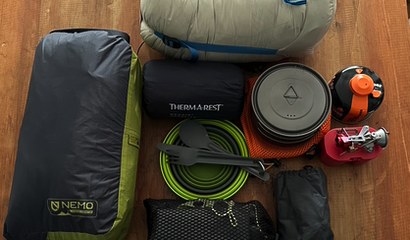
Camping Equipment
For my bike tour, I carried lightweight and compact camping gear to make my journey comfortable and efficient:
n Tent: NEMO Hornet OSMO™
n Sleeping bag: Ultralight, Sea to Summit
n Sleeping pad: Ultralight, Therm-a-Rest NeoAir UberLite
n Pillow: Ultralight, Nemo
n Stove: MSR PocketRocket 2 Mini Stove Kit
n Pot: TOAKS Titanium 700ml
n Cutlery & cup: Titanium, Sea to Summit
n Plate: Multifunctional camp bowl, packs flat, Sea to Summit
n Basic first aid kit
This setup allowed me to camp comfortably while keeping weight and bulk to a minimum, perfect for long days on the road.
8. What type of bicycle did you use and what was your cycle touring equipment?
I rode a Marinoni touring bicycle, custom-built by Montreal-based manufacturer Giuseppe Marinoni—a renowned frame builder in North America and an Italo-Canadian family heirloom. This bike was ideal for long-distance touring and allowed me to attach Tubus luggage racks at the front and rear, as well as on the handlebars, where I loaded Ortlieb travel bags, also known as “panniers.” One of the most important aspects of cycle touring is organizing your gear and distributing the weight for a stable and comfortable ride.
My bike was also equipped with front and rear fenders, a rear-view mirror, a bell, three water bottles, a lock, and, of course, a helmet. For each trip, I adapted the setup slightly depending on the route and conditions.
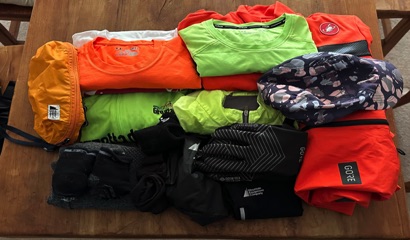
As for clothing, the weather was fairly consistent along my route, so I relied on a layering system that allowed me to add or remove garments as needed, and I always carried a Gore-Tex rain jacket. I wore dedicated cycling shoes all-mountain MTB shoes with pedals that were flat on one side and SPD-compatible on the other. I love shoes that let you walk comfortably off the bike, and I also brought walking sandals for camping and casual wear.
3. The Question I Was Asked Most: “Aren’t You Afraid to Bike Alone, as a Woman?”
During my journey, this question came up often. My answer was always the same: I’m not afraid I’m careful. Of course, there were moments when men asked inappropriate questions that didn’t deserve an answer. In those cases, I simply ended the conversation as quickly as possible, smiled, and moved on riding away or walking away became a kind of shield, a small “vaccine” against discouragement.
Safety was always a priority. Before leaving, I shared my location with my brother in Italy using an AirTag, and also shared my location via my phone. Throughout the journey, I regularly sent texts or photos to family and friends, keeping them updated on where I was and where I planned to be the following day. This gave me freedom to explore while ensuring my loved ones knew I was safe.
4. What else can you say about the regions you've cycled through and what fascinated you?
I truly savored every single moment of this journey. It was a unique experience worth discovering breathtaking scenery, challenging terrain, the pleasure of uncovering new places, and the joy of meeting local people and experiencing warm Italian hospitality all combined to create an unforgettable cycling adventure.
What fascinated me most was crossing the regions and feeling as if I were attending a concert of singer-songwriters. Each region seemed to sing its own unique song, with distinct dialects, accents, intonations, and rhythms. Italy, in all its diversity, became a grand symphony—a living, breathing language of music that I could experience with every turn of the pedals.
5. Do you have an exciting tale to tell from your two-wheeled journey?
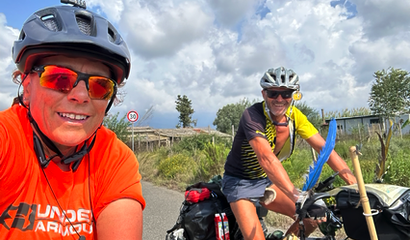
One of the most exciting and enriching encounters happened by chance while I was eating a sandwich at a local shop. A German man named Hartmut stopped, exchanged a few words, and asked where I was headed. I told him I was traveling to Reggio Calabria to continue my journey along the Italian peninsula—and, incredibly, he was headed there too, planning to catch the ferry to Sicily at Villa San Giovanni along the way. That spontaneous connection perfectly captured the spirit of adventure I love: the joy of meeting people on the road, sharing stories, and discovering common paths in the most unexpected ways.
Personally, I don’t make reservations; I love the spirit of adventure and adapting to the moment. This requires independence, self-confidence, and a willingness to embrace uncertainty.
After a long day in the saddle, finding a place to stay depends on where you are. Even then, solitude rarely feels like loneliness—there’s always something to do. I love camping because it allows me to fully enjoy nature. It’s a bit more challenging, with routines and tasks to manage, but it also offers beautiful moments outdoors before nightfall. Later, I write or voice-record my travel diary, text friends and family, study the map, and visualize the next day before quickly falling asleep.
Solo travel has both advantages and disadvantages, and it’s not always an obvious choice. But once you try it, you’ll realize the unique joys it offers—and I highly recommend giving it a shot, even if just once.
After meeting, we cycled together for a few days and quickly became good friends and cycling partners. I learned so much from him (thank you!), and even now, we continue to feel connected.
Hartmut left his job years ago to see the world by bicycle, and he has never returned. For the last 15 years, he has lived a solo, nomadic life, carrying everything he owns in his bicycle bags—around 80 kilos in total. He lives simply, choosing a sustainable lifestyle that, as he says, feels “more human.”
He has undertaken countless bicycle journeys and continues to do so. In recent years, he travels every winter from Germany to Sicily, driven by a remarkable desire to keep exploring and embracing new adventures.
9. How much does your gear weigh, including your bike and all the gear?
My full bike touring setup weighed between 38 and 42 kg, depending on whether my three water bottles were filled and if I was carrying extra food.
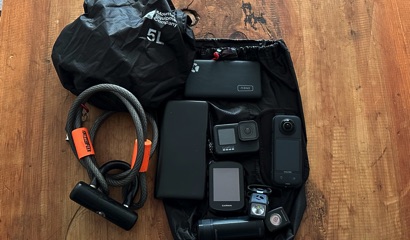
A significant portion of that weight came from electronic equipment my iPhone, an action camera (GoPro or Insta360 X3) with batteries and chargers, power banks as well as essential repair tools and a strong lock. These things add bulk, but it’s a conscious choice. For me, documenting the trip is part of the fun, so I happily accept the extra kilos.
Because it was summer, I was able to keep clothing fairly minimal, and my camping gear was ultralight. Still, traveling independently is never “light.” Over the years, though, I’ve learned how to refine my packing, cut unnecessary items, and carry only what I really need. That balance gives me maximum freedom on the road, with everything I require securely loaded on my bike.
10. How do you create your cycling adventure, and what are your goals while on the bike?
One of the most challenging aspects of cycle touring is finding the right balance between planning and freedom. I prepare only what’s necessary to keep the journey safe and enjoyable: choosing the right setup, the right roads, and the right tires. For this trip, I fitted my bike with 35mm hybrid tires, perfect for both asphalt and dirt roads, so I could follow wherever my curiosity took me.
On this ride, I built the route day by day. I didn’t follow anyone else’s trail or a fixed itinerary everything was improvised. My navigation came from Google Maps or Komoot, which I often cursed for sending me onto some brutal sections: bike paths that turned into rough farm tracks, dirt roads through the countryside, even trails in the woods where riding was impossible. But that, to me, is part of the adventure.
My adventures are always a mix of research, instinct, and chance encounters. This particular journey wasn’t too demanding simply following the coast didn’t require much planning but on past trips in Canada and the United States, I had to plan more carefully because of the vast distances between towns. Usually, I just sketch a basic outline before setting off. Daily stages depend on my energy, the terrain, and what I discover along the way. Often, I don’t even know where I’ll spend the night until the day is over. That unpredictability is what makes the experience feel authentic and alive.
My goals in the saddle are simple yet meaningful: to explore new places, push myself on long distances or steep climbs, and embrace the elements. Even the wind, pushing hard against me, becomes part of the adventure. It challenges me, but it also fuels me. Every pedal stroke carries a sense of freedom, discovery, and joy.
For me, cycle touring isn’t about rigid destinations it’s about the spontaneous magic of the journey itself.
12. Have you followed any of the cycling routes of the Tyrrhenian Cycle Route (Ciclovia Tirrenica)? What was the most evocative stretch of road along the route?
Yes! The Ciclovia Tirrenica (BI190) is an ambitious cycling route that currently crosses Liguria, Tuscany, and Lazio. It combines reconverted disused railway lines, dedicated cycle paths, and low-traffic roads to create a mostly continuous coastal path. Along the way, cyclists enjoy stunning views of the Tyrrhenian Sea, charming towns, and scenic landscapes. Although still under development, the Tirrenica aims to extend further south in the near future, becoming one of Italy’s premier long-distance cycling experiences.
My favorite stretch is the Ciclovia della Riviera dei Fiori in Liguria, also known as the Cycling Riviera. This section follows a reconverted old railway, offering smooth riding and spectacular sea views. The combination of coastal panoramas, charming villages, and well-maintained paths makes it a true highlight.
In Tuscany, the stretches along the Versilia coast are breathtaking. Smooth cycle paths run parallel to sandy beaches and pine forests, with the Apuan Alps rising in the background. The mix of sea breeze and scenic mountains creates a sensory delight for any cyclist.
Finally, in Lazio, the route gradually transitions from the coast to rolling countryside, passing through olive groves, vineyards, and quiet country roads. Approaching Rome, the combination of fading sea views, historical landscapes, and old bridges creates a truly evocative ride, where you can almost sense the centuries of travelers who passed this way before you.
13. Have you followed any of the cycling routes of the Adriatic Cycle Route (Ciclovia Adriatica)? What was the most evocative stretch of road along the route?
Yes, I followed several sections of the Ciclovia Adriatica (BI6), a long-distance cycling route of approximately 1,300 km, making it one of the longest cycle paths in Europe. It crosses seven Italian regions: Friuli Venezia Giulia, Veneto, Emilia Romagna, Marche, Abruzzo, Molise, and Puglia.
Most of the route runs along secondary roads with little traffic, offering a peaceful and scenic ride. There are also sections along the SS16, the Adriatic State Road, which connect the coastal stretches.
For me, the most evocative section was the Costa dei Trabocchi in Abruzzo. This 42-kilometer stretch, built on a reconverted old railway, offers smooth cycling and breathtaking views of the Adriatic Sea. Along the way, you’ll encounter the iconic trabocchi, traditional wooden fishing platforms that extend into the sea, as well as charming coastal towns like Ortona, San Vito Chietino, and Fossacesia. The mix of panoramic sea views, historic fishing structures, beaches, and nature reserves makes it a truly unforgettable ride.
Technological Accessories & Bike Repair Equipment
To stay connected, navigate effectively, and maintain my bicycle, I carried the following technological and repair gear:
Technological Accessories
n GPS cycle computer
n Front and rear lights
n Power banks
n Smartphones
n Action cameras
n USB cables and power socket
n Victorinox Swiss Army Knifecamp bowl, packs flat, Sea to Summit
Bike Repair Kit & Tools
n I tailored my repair kit to the trip, bringing only the essentials since I could find bicycle shops along the route. My kit included:
n Spare inner tubes
n Patch kit
n Pump and tire pressure gauge
n Cycling multi-tool (with Allen keys, screwdrivers, and wrenches)
n Mix of spare components
n Oil and rag
This setup allowed me to handle minor mechanical issues on the road while keeping weight manageable, ensuring smooth and uninterrupted travel.
11. Have you ever wondered where to stay overnight when you are traveling by bike?
For me, every day on a cycling adventure is about flexibility and freedom. I rarely worry in advance about where I’ll sleep I prefer to decide in the moment, depending on where I end up at the end of the stage. That unpredictability is part of the charm.
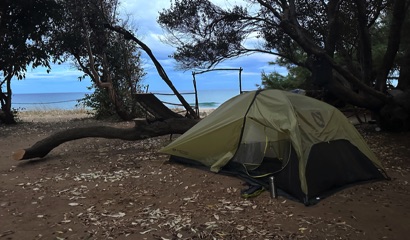
As an outdoor enthusiast and a true lover of camping, there’s nothing more rewarding than ending a long day in the saddle surrounded by nature. Sleeping under the stars in my tent feels far richer than a hotel or B&B. Carrying my little “home” with me gives a sense of self-sufficiency and joy, and I believe cycling and camping naturally go hand in hand in creating a simple, eco-friendly journey.
Sometimes I also bivouac a short-term overnight stop set up after sunset and packed away before sunrise. This is often confused with wild camping, which is different and more regulated. Across Europe, bivouacking is usually tolerated, while wild camping isn’t always legal. In North America, I’ve done both, always following the Leave No Trace principles: choosing discreet, isolated spots, packing out all waste, and using biodegradable soaps.
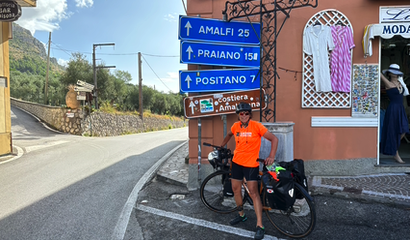
That said, I’ve also stayed in B&Bs, hotels, and even once in a hostel on the Amalfi Coast in Sorrento. It was clean and well-organized, but not really my style I prefer the simplicity of a tent and the closeness to nature.
For me, cycle touring isn’t about rigid destinations it’s about the spontaneous magic of the journey itself.
6. How was the reception from the local inhabitants, and what kind of encounters did you have during the trip?
One of the best things about cycle touring is the wonderful people you meet along the way locals who are eager to share their stories, daily routines, and knowledge of the area. These encounters open doors, create connections, and often lead to lasting friendships with both residents and fellow travelers.
The people I met, regardless of age or gender, were consistently friendly, warm, and generous. Many went out of their way to help me, and I was continually surprised by the affection and hospitality they showed. It was incredible how much I learned from them, the local roads they recommended, and the enthusiasm and compliments they offered. These interactions added a deeply human dimension to my journey and made the experience all the more enriching.
7. Did anything interesting happen during the trip?
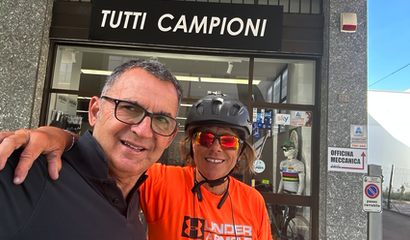
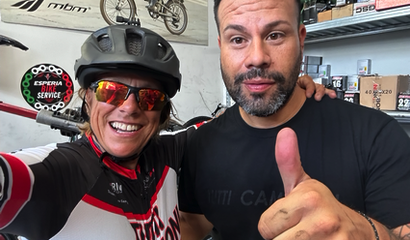
Yes one unforgettable event happened on my birthday. I had some problems with my brakes and decided to stop at a shop called TUTTI CAMPIONI in Porto Sant’Elpidio, Marche, which a local had recommended while I was enjoying a cappuccino at a nearby café.
When I walked into the shop with my loaded travel bicycle, two smiling faces greeted me, asking what I needed. One was the owner, Vincenzo Santoni, a former Italian road cyclist active in the 1980s. With great enthusiasm, he showed me the T-shirts he had won and displayed photographs from his races. His collaborator, Gabriel also a cyclist checked my brakes with impressive professionalism.
At the end of the visit, Vincenzo surprised me with a cycling shirt that read “We Are All Champions” because it was my birthday. I put it on immediately, and before I left, Vincenzo even interviewed me on his cell phone, asking questions about my journey. I continued cycling with joy, wearing that beautiful jersey a birthday memory I will never forget!
The suprising interview of Vincenzo Santoni - Look the interview